Rotator Cuff Tears
What Happens When You Tear Your Rotator Cuff?
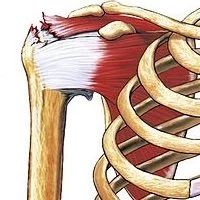
The rotator cuff is a group of muscles and tendons that hold the top of the arm bone in the shoulder socket and power arm rotation and lifting. A tear — whether from a single injury or gradual wear — can cause pain, weakness, and difficulty raising the arm. Some tears respond to therapy alone; larger or complete tears in active patients often need surgical repair to restore full strength.
How Rotator Cuff Tears Happen
Tears generally fall into two categories. Acute tears happen suddenly — a fall onto an outstretched arm, a heavy lifting injury, or a shoulder dislocation. Degenerative tears develop gradually over years, often related to repetitive overhead motion, aging tendon tissue, or reduced blood flow to the rotator cuff as we get older. It's common for a degenerative tear to exist for a long time before it becomes symptomatic.
Recognizing the Symptoms
Pain along the outside of the shoulder or upper arm, often worse at night
Weakness lifting the arm, especially overhead
A feeling of catching, popping, or grinding with movement
In complete tears, sometimes an inability to lift the arm away from the body at all
Diagnosis:
A focused physical exam checking strength and specific movement patterns is often enough to suspect a tear. MRI is typically used to confirm the diagnosis, measure the size of the tear, and evaluate the quality of the remaining tendon and muscle — details that directly affect the surgical plan if surgery becomes necessary.
Treatment Options
Nonsurgical:
Physical therapy to strengthen the surrounding muscles, activity modification, anti-inflammatory medication, and corticosteroid injections for pain control — often the first approach for smaller or partial tears, particularly in lower-demand patients.
Surgical:
Arthroscopic rotator cuff repair, performed through small incisions with a camera, reattaches the torn tendon to the bone using suture anchors. This is generally recommended for full-thickness tears in patients who remain symptomatic despite nonsurgical treatment, or for larger tears in active individuals where waiting risks the tear enlarging or becoming irreparable.
Frequently Asked Questions:
Can a rotator cuff tear heal on its own?
Small partial tears occasionally stabilize with therapy and activity changes, but true full-thickness tears do not heal without surgical repair — the tendon ends are separated and won't reattach on their own.
How long is recovery after rotator cuff repair?
Most patients are in a sling for 4-6 weeks, begin therapy shortly after surgery, and see meaningful strength return over 4-6 months, with continued improvement for up to a year.
Is rotator cuff surgery done arthroscopically?
Yes, in the large majority of cases — arthroscopic repair typically means less postoperative pain and a faster initial recovery compared to open surgery.
Dr. Williams has extensive experience treating rotator cuff tears. If you are dealing with shoulder pain or weakness, Dr. Williams will discuss the best treatment options for your condition.
Call 801-533-2002
Ben Williams, MD
Comprehensive Orthopedics and Sports Medicine
801-533-2002
Arthroscopic Rotator Cuff Repair
What to expect before surgery
Dr. Williams and/or Sean Kendall, PA-C will go over the results of your imaging and go over the risks of surgery and pick a date
We will obtain authorization from your insurance for the surgery
The hospital will call the afternoon before with instructions for the day of surgery such as when to stop eating and drinking, what medications to stop, and when to arrive.
All GLP-1 agonists (Ozempic, Wegovy, Mounjaro, etc.) will need to be stopped at least a week before surgery). Most blood thinners need to be stopped 5 days before surgery.
What to expect the day of surgery
The anesthesiologist will discuss a nerve block
The surgery will take approximately 1-2 hours
You will wake up with a sling and an ice machine. The nurses will show you how to get dressed and how the sling and ice machine work before you leave.
What to expect the first few days after surgery
You will be prescribed narcotic pain medication. If you get a nerve block, your arm will likely be numb for around 20 hours. Take 600-800mg of ibuprofen (unless you cannot take NSAIDs) on the evening after surgery. Take this every 8 hours for the first few days and supplement with the narcotic pain medication as needed.
Remove sling only to change your clothes. Wear your sling at all times, including while sleeping, for 6 weeks.
Use the ice machine as long as needed.
Keep your incisions dry. You can cover up the dressing with Glad Press-n-Seal in order to shower.
Call and make an appointment for 10-14 days after surgery to remove your sutures.
Rotator Cuff Repair: Patient Recovery Guide
This handout outlines what to expect following your rotator cuff repair surgery and the different phases of recovery. Please follow your surgeon's specific instructions, as individual recovery may vary.
Phase 1: Protection and Passive Motion (0-6 weeks)
Wear your sling at all times, including while sleeping, for 6 weeks
Remove sling only for showering and prescribed exercises
Focus on pain reduction and tissue healing
Perform passive range of motion exercises as directed by your surgeon
Avoid active shoulder movements or reaching behind your back
Phase 2: Active Motion (6-12 weeks)
Your sling will be removed at the start of this phase
Begin formal physical therapy 2-3 times per week
Gradually return to active movements and functional range of motion exercises
Continue to avoid motions behind your back for 8 weeks post-surgery
Phase 3: Strengthening (12-22 weeks)
Focus on strengthening exercises for the rotator cuff muscles
Use light resistance bands or weights as directed by your therapist
Continue stretching exercises to maintain and improve range of motion
Phase 4: Full Activity (4-6 months and beyond)
Gradual return to full activities and sports, as approved by your surgeon
Continue home exercise program to maintain strength and flexibility
Full recovery may take 4-6 months, with maximum improvement up to 9-12 months
Important Reminders:
Follow your surgeon's and physical therapist's instructions carefully
Attend all scheduled follow-up appointments and therapy sessions
Be patient with your recovery; healing takes time
Contact your healthcare provider if you experience increased pain, fever, or other concerning symptoms
Remember, everyone's recovery is unique. Your healthcare team will guide you through each phase based on your individual progress and needs.
Background:
What is an Arthroscopic Rotator Cuff Repair?
The principle of arthroscopic rotator cuff surgery is to reattach the torn tendon back to the humerus (ball) and address any other areas of concern at the same time – biceps tendon, shoulder spur, bursitis, acromioclavicular joint, and shoulder joint capsule. The procedure is almost always carried arthroscopically and is an outpatient surgery. Patients are in a sling for six weeks and start physical therapy at four weeks post-surgery.
What conditions does an Arthroscopic Rotator Cuff Repair treat?
The main area of concern is the torn rotator cuff (supraspinatus tendon tear is the most common); the following areas are also addressed if needed:
Biceps tendonitis
Acromioclavicular joint (AC Joint) arthritis
Subacromial bursitis
Subacromial spur (Shoulder spur)
Shoulder joint capsulitis
Glenoid labrum tear (anterior and/or posterior labrum)
The decision to address these areas is best made in the office during your consultation – this is based on a careful history, physical examination, imaging review (MRI), and discussion with the patient about their expectations and functional requirements. In a small number of cases, unexpected findings are made at surgery and Dr Williams will undertake the treatment that provides you with the best outcome.
How is an Arthroscopic Rotator Cuff Repair performed?
The procedure is performed under a General Anesthetic
Small key-hole incisions (about ½ inch long) are made and the camera and surgical instruments are placed inside the shoulder. Usually 4-6 incisions are enough to carefully repair the shoulder
A thorough 15-point examination of the shoulder joint is made via the arthroscopic camera and pictures are taken to document findings.
Biceps
The first step is to address the biceps tendon if needed
The biceps tendon will either be moved out of the shoulder joint or re-anchored in the armpit at the start of the case. Studies have shown that in most cases, simply detaching the biceps tendon will not affect function and will relieve biceps-related pain.
Bone Spur and Bursa
Next, attention is turned to the area above the tendon and any bursitis is shaved away carefully and the bone spur is identified.
A special 5.5mm metallic burr is then used to shave away the spur and create more room to allow the tendon to move freely.
Rotator Cuff Tear
If there is a tear (as identified on the MRI pre-surgery) then it is carefully assessed and cleaned up. The tear is mobilized to allow for a tension-free repair and the Humerus (ball) is prepared to accept the anchor.
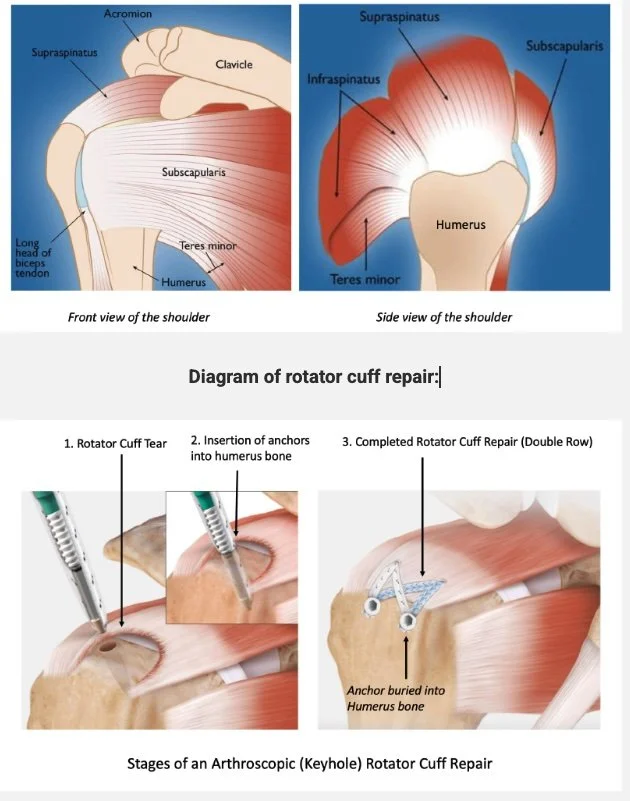
Suture anchors are then placed into the Humerus (ball of the shoulder joint) and sutures are passed through the tendon and repaired to bone (as seen in the picture below)
There are many special techniques to obtain a good repair and your shoulder surgeon is well versed in this.
AC Joint Resection
If this joint was identified as a pain generator during your examination, then about 7mm of bone from the end of the collar bone is removed.
All of the wounds are then closed and dressings applied. Your arm will be placed in a sling.
Diagram of rotator cuff repair:
Click this link if you would like to watch an animation of one of the most common repair techniques used by Dr. Williams:
https://www.youtube.com/watch?v=3OaWXXEdS7g
What are the risks of Arthroscopic Rotator Cuff Repair?
General Shoulder Surgery Risks
Surgery is a carefully choreographed process and you are being treated by a sub-specialist shoulder surgeon and a highly experienced team; however, all surgeries inherently carry some risk of complications, such as (all are below 1%). General risks include:
Infection
Nerve injury
Bleeding
Failure of the repair to heal
Specific Shoulder Surgery Risks
Frozen Shoulder
Frozen shoulder occurs when the shoulder joint capsule becomes inflamed, red and scarred – it initially presents with severe pain, then progresses to stiffness and thaws out over many months
After routine shoulder surgery, the risk of frozen shoulder is 5%
There is nothing your surgeon can do to reduce this risk
This risk is around 10% if you have a history of Diabetes or Thyroid disorders.
Occasionally the frozen shoulder will not improve with physical therapy and another operation may be necessary
Reoperation and failure of surgery
When performing a shoulder reconstruction, your surgeon is using your own tissue to repair what is damaged. The weakest point in the repair is your own tissue. The longer the history of damage and frequency of trauma prior to surgery, the more likely the tissue quality is poor. Other factors like Smoking and Diabetes may also reduce your tissue quality. The risk of re-tear or non-healing of the tendon is around 5-20%, but can be much higher in older patients with very large tears.
Driving after shoulder surgery
It is not advisable to drive while you are wearing the sling (first 6 weeks). However, some patients do drive a limited amount after they are off of the narcotic pain medication.
Showering and getting dressed
You may take the sling off to shower
Lean forward and allow your arm to “dangle” to wash under your arms
Keep the dressings dry for the first 4 days.
When getting dressed, you may use your good arm to move your affected (operated arm) to place your arms through the sleeves carefully
Sleeping after Shoulder Surgery
Most patients find it difficult to lie flat after shoulder surgery.
Consider using a recliner or few pillows to prop yourself up and sleep at a slight incline; this may be necessary for 4-6 weeks after surgery. You should keep your sling on while asleep.
Elbow and hand movement
Keep your elbow and hands joints moving and supple for the duration of time you are in the sling. The best time to move your elbow (into full extension and flexion) is when you are in the shower, just out of the shower and about to get dressed.
Video on how to sleep after shoulder surgery:
https://www.youtube.com/watch?v=_TrriojRJ_o&t=2s
How to get dressed and undressed after shoulder surgery: